
We Deliver — Free in Palm Beach for Orders Over $49.99

Hamptons Team | 12 hours ago

The Gravity of the Tin: Why You Need to Stop Rationing Caviar

We have all been there. You know caviar as the polite dollop resting on a cold blini, or a decorative garnish on a catering platter. It was salty, it was fancy, and it was over in a single, fleeting bite. You walk away thinking, “It’s good... but is it really worth the hype?”


I used to think the exact same thing. In fact, I completely wrote caviar off for years. Growing up, my grandmother would tell me stories that sounded like pure mythology:


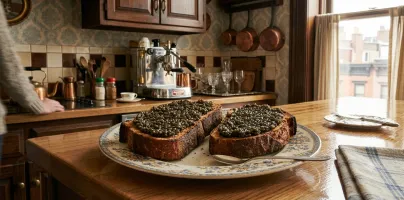
"Back in the '80s, my absolute favorite afternoon snack was two warm slices of bread, spread with a thick, glistening layer of Caspian Beluga caviar. Especially when I was pregnant with your dad, I would finish lunch and just count down the minutes until 4:00 PM so I could have my daily treat. It was my happiest ritual."


For decades, she dreamed of those days. And for decades, I didn’t quite get it, because what she casually enjoyed had become completely impossible.


To put her daily habit into perspective: during the famous "Beluga Caviar War" of 1983 between Zabar's and Macy's in New York, a massive 14-ounce tin of wild Caspian Beluga retailed for around $119. Even with inflation, that’s about $380 in today’s money.


Today, if you wanted to buy a 14-ounce tin of purebred Beluga to casually spread on your afternoon toast, it would set you back nearly $4,000. Unless you have a casual quarter-million-dollar annual grocery budget, nobody is eating pure Beluga on a daily basis anymore.


But it wasn't just the price that made it impossible—the legendary quality itself had vanished.

The Tragic Transition

To understand why we’ve been conditioned to settle for tiny, underwhelming dollops, you have to look at what happened after my grandmother's era. In the ’80s, wild Caspian Sea Beluga was the pinnacle of luxury—creamy, buttery, and abundant. But by the early 2000s, overfishing and strict trade bans caused the global supply of wild sturgeon to plummet by over 90%.


For two decades, the market panicked. Because sturgeon are incredibly slow-growing—taking anywhere from 7 to 20 years to harvest depending on the species—commercial brands rushed the process. The market was flooded with hurried, blended, over-salted, and pasteurized commercial tins.


That is the caviar my generation grew up eating. It was literally "expensive salt." No wonder my grandmother said the magic was gone, and no wonder you’ve probably felt underwhelmed by it at parties.


When we recently sat down to sample the newest arrivals at our shop, our entire perception of this ancient delicacy was rewritten. We didn't just eat caviar; we finally tasted it.


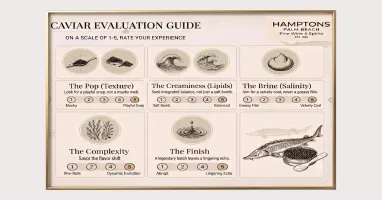
If you have ever paused to figure out why a tiny bead of sturgeon roe has the power to hold an entire room hostage, the secret isn’t just the luxury status; it’s the structural brilliance of the food itself. To talk about it like a true connoisseur while you indulge, mentally score the allocation across these five core dimensions of structure:

The Theory is Great. The Tasting is Better.

Join us for a complimentary experience July 17th 4pm - 6pm

At a lively party, you rarely get the chance to slow down and isolate these details. You get a single fleeting bite, a quick sip of whatever bubble is nearby, and the moment passes.


We think the best way to truly learn what you love is to taste the world's best terroirs side by side, completely uninterrupted. Join us at our Palm Beach boutique this Friday, July 17th, from 4:00 PM to 6:00 PM for an exclusive global flight. We will be opening and evaluating four distinct expressions of world-class caviar side by side:


Beluga Hybrid (Bulgaria):

Celebrated for its pristine Balkan mountain water profiles and elegant, clean clarity.

Persicus Oscietra (Azerbaijan):

Rich with the deep, complex history and classic brine of the old-world Caspian basin.

Oscietra de la Sombra (Spain):

A modern powerhouse of organic sustainability, known for an ultra-pure, smooth texture.

Kaluga Hybrid (China):

The current darling of the global culinary elite, producing massive, architectural pearls with an unforgettable buttery lipid profile.


We will be pairing the entire flight with crisp, high-acid sparkling designed to cut through the richness and keep your palate perfectly calibrated


Come ready to taste, score, and find your definitive favorite!

The Five Dimensions of Taste

1. The Pop (Texture)

Look for a playful snap, not a mushy melt.

The physical structure of the egg membrane is the ultimate trigger for that sensory experience. A great Amber Oscietra features a distinct, playful pop that requires deliberate pressure against the roof of your mouth. By contrast, a classic Beluga Hybrid is beautifully delicate, collapsing effortlessly on the tongue.


2. The Brine (Salinity)

Seek integrated balance, not just a salt bomb.

Beginners just taste salt; professionals look for harmony. High-end, traditional Malossol (low-salt) cures keep the salinity below 4%. This frames and enhances the rich egg flavor rather than masking it behind harsh, stinging sodium.


3. The Creaminess (Lipids)

Aim for a velvety coat, never a greasy film.

Once the egg pops, focus entirely on the weight of the yolk. The benchmark for a world-class Kaluga Queen is an ultra-creamy, buttery texture that cleanly coats the palate and then vanishes without leaving a trace of heavy oiliness.


4. The Complexity

Savor the flavor shift after the initial "sea breeze" fades.

This is where the true seduction happens. As the initial salinity settles, a trained palate will pull out stunning secondary notes hiding on the mid-palate—think toasted almond, warm brioche, clean iron, or even wild mushroom.


5. The Finish

A legendary batch leaves a lingering echo;cheap roe pulls a vanishing act.

The ultimate indicator of quality is persistence. While a commercial, rushed roe disappears the second you swallow, an exceptional allocation leaves a pleasant, sweet-savory memory on the back of your palate for a minute or more.

Sincerely yours,

Hamptons Team

More Posts

<p>The Palm Beach Corkage Guide: Fees, Etiquette, and the Best BYOB Policies on the Island</p><p>The Palm Beach Corkage Guide: Fees, Etiquette, and the Best BYOB Policies on the Island</p>

The Palm Beach Corkage Guide: Fees, Etiquette, and the Best BYOB Policies on the Island

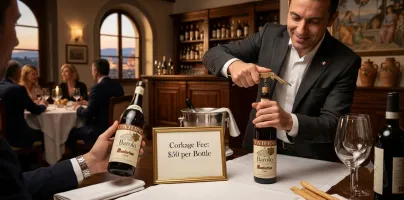
Around here, we are no strangers to precision when it comes to wine. At our Palm Beach boutique, our days are spent curating cases for everything from elegant backyard luncheons to grand weddings at the Flagler Museum. But just as often, the assignment is beautifully simple: a regular walks through our doors looking for that one perfect bottle to bring out to dinner that very evening.


Historically, taking a bottle from your cellar to a local dining room came with a side of guesswork, as corkage policies varied wildly by doorstep. That baseline is shifting toward welcome clarity. With Florida’s landmark SB 606 fee transparency law now in effect as of July 1, 2026, automatic operations charges must be clearly itemized on menus and receipts. Under this new legislation, restaurants provide upfront notice of their exact corkage fees, removing the mystery for collectors before the first cork is even pulled.


As the law brings these fee structures into the light, there has never been a better time for our community of collectors to brush up on the unspoken etiquette of BYOB. Done right, corkage isn't just a transaction—it’s a dynamic, two-way dialogue between an engaged diner and a world-class hospitality team, turning the bottle you meticulously selected into a shared conversation.


"Corkage gives restaurants an unexpected window into what guests are excited enough to purchase for themselves or gift to others," notes Megan, Sommelier at Harry’s West Palm Beach. "It helps us understand evolving tastes and can even influence future decisions about what deserves a place on the wine list."